
The main difference between a commercial manager and a quantity surveyor is their responsibilities. A quantity surveyor (QS) typically manages project costs, valuations and contracts, while a commercial manager oversees commercial performance, financial risks and key business decisions.
Both roles help construction companies control spending, manage contractual obligations and protect project profitability. However, their responsibilities can overlap depending on the contractor’s size, project complexity and management structure.
This guide compares their duties, explains how they work together and explores career progression within UK construction.
Commercial Manager vs Quantity Surveyor: Key Differences
A quantity surveyor focuses on the detailed costs and contractual requirements of construction work. A commercial manager takes broader responsibility for commercial performance, financial risks and decisions across projects or contracts.
The table below compares their typical responsibilities within a construction company.
| Aspect | Quantity Surveyor | Commercial manager |
| Primary focus | Project costs and contractual value | Overall commercial performance |
| Main responsibilities | Cost planning, valuations and contract administration | Commercial strategy, risk and financial oversight |
| Project involvement | Manages assigned projects or work packages | Oversees projects, contracts or commercial teams |
| Budget management | Tracks costs against project budgets | Reviews budgets and financial performance |
| Procurement | Evaluates tenders and subcontractor quotations | Oversees major procurement decisions |
| Variations | Measures, prices and manages changes | Reviews significant claims and commercial risks |
| CVR reporting | Prepares cost and value information | Reviews CVR results and agrees actions |
| Forecasting | Estimates final costs and contract values | Assesses forecasts and expected profitability |
| Decision-making | Works within delegated commercial authority | Usually has broader commercial authority |
| Team management | May supervise junior surveyors | Often manages QS and commercial teams |
| Reporting | Usually reports to a Senior QS or Commercial manager | Often reports to a Commercial Director or senior management |
These responsibilities vary between contractors. A senior quantity surveyor may handle several commercial management duties, while a commercial manager on a major project may stay closely involved in valuations, procurement, and contract administration.
Keep job costs, labour, purchase orders and project spending organised and up to date with LiveCosts.
What Does a Quantity Surveyor Do?
A quantity surveyor manages the financial and contractual aspects of construction work. Their main responsibility is to measure, value and monitor costs throughout a project, from the initial estimate to the final account.
Quantity surveyors work with project managers, subcontractors, suppliers and commercial teams to keep costs accurate and support contractual payments.
They may work for main contractors, subcontractors, consultancies or clients. Their responsibilities depend on which organisation they represent.
Key Responsibilities of a quantity surveyor
A contractor-side quantity surveyor typically handles:
- Cost estimating: Preparing cost plans, reviewing quantities and assessing expected construction expenditure.
- Budget monitoring: Comparing actual and committed costs against approved allowances.
- Procurement: Evaluating subcontractor quotations, preparing tender documents and supporting subcontract awards.
- Valuations: Preparing or assessing payment applications based on completed work and contractual requirements.
- Variations: Measuring and valuing changes to the agreed scope.
- Cost reporting: Preparing cost forecasts, CVRs and financial updates.
- Final accounts: Agreeing the final value of completed work and closing subcontract accounts.
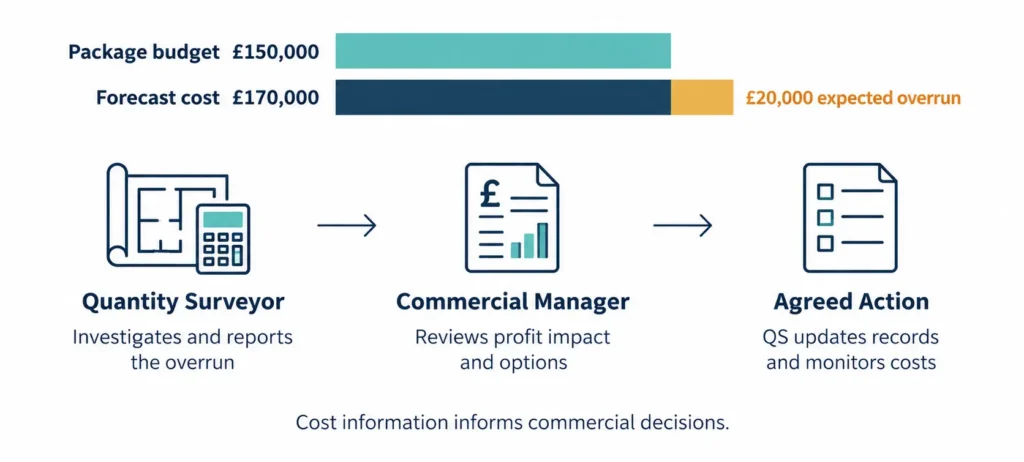
For example, a QS managing a £150,000 electrical package may review subcontractor valuations, assess variations and project final outturn.
These activities help the contractor understand spending, contractual value and the financial outcome of individual work packages.
What Does a Commercial Manager Do?
A commercial manager oversees the commercial performance of construction projects, contracts or business operations. The role combines financial management, contractual knowledge, risk assessment and commercial leadership.
Commercial managers review project profitability, manage significant contractual issues and support decisions that affect the contractor’s financial performance.
In larger construction companies, they may oversee several projects and manage a team of quantity surveyors. On major contracts, a commercial manager may focus on a single project with substantial financial and contractual responsibilities.
Key Responsibilities of a Commercial manager
A commercial manager typically handles:
- Commercial planning: Establishing commercial objectives and overseeing financial performance.
- Financial oversight: Reviewing project budgets, forecasts, CVRs and expected margins.
- Risk management: Identifying contractual and financial risks that could affect profitability.
- Contract management: Overseeing significant contractual obligations, disputes and claims.
- Procurement oversight: Reviewing major subcontract awards and commercial terms.
- Commercial reporting: Presenting financial performance and risks to senior management.
- Team leadership: Managing quantity surveyors and supporting commercial decisions.
For example, a commercial manager may review financial reports across several construction projects to identify declining margins or significant cost overruns.
They can then work with quantity surveyors and project managers to investigate the causes and agree on corrective actions.
The role focuses on ensuring that commercial decisions support the contractor’s financial objectives.
Where Do Commercial Managers and Quantity Surveyors Overlap?
Commercial managers and quantity surveyors often share responsibilities for budgets, contracts, procurement and project financial reporting.
The main difference is usually the level of responsibility and authority each person holds.
| Shared responsibility | quantity surveyor’s involvement | Commercial manager’s involvement |
| Cost control | Monitors expenditure and identifies variances | Reviews cost performance and agrees actions |
| Contract management | Manages valuations, notices and variations | Oversees significant contractual risks and decisions |
| Procurement | Evaluates quotations and subcontract costs | Reviews major awards and commercial exposure |
| CVR reporting | Prepares cost and value information | Reviews results and assesses financial risks |
| Forecasting | Updates expected costs and contract values | Reviews the effect on project profitability |
Both professionals need accurate financial information to perform their duties.
For example, a quantity surveyor may identify that outstanding purchase orders will exceed a work package’s remaining budget. The commercial manager can review the wider financial implications and agree how the team should respond.
Their responsibilities overlap because quantity surveying forms an important part of construction commercial management.
However, job titles alone do not determine authority. The contractor’s organisational structure and delegated responsibilities define who prepares, reviews and approves commercial decisions.
Keep job costs, labour, purchase orders and project spending organised and up to date with LiveCosts.
How does CM and QS Work Together?
Commercial managers and quantity surveyors work together by sharing project cost information, reviewing financial performance and making decisions that protect profitability.
The QS usually provides detailed commercial information, while the commercial manager uses that information to assess risks and guide decisions.
Is a commercial manager superior to a quantity surveyor?
A commercial manager generally holds a more senior position than a quantity surveyor within a contractor’s commercial team. The role often includes greater decision-making authority, responsibility for financial performance and management of other commercial professionals.
A typical career structure may look like this:
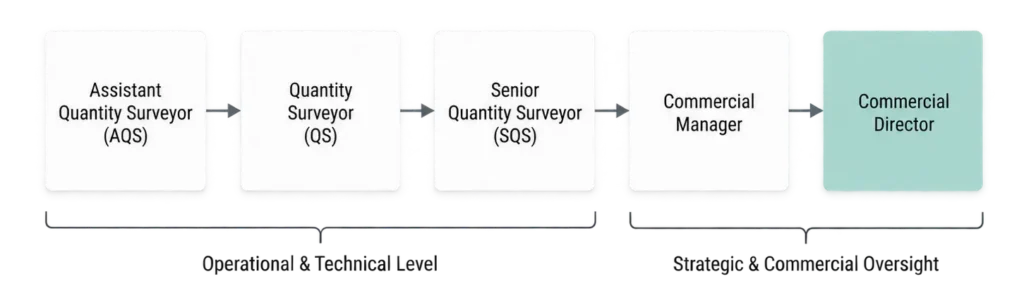
However, not all construction companies follow the same reporting structure.
On major projects, senior quantity surveyors drive commercial strategy, manage large budgets, and lead teams.
Similarly, main contractors appoint Commercial managers to individual projects rather than placing them above every QS in the business.
The distinction depends on responsibilities, experience and organisational structure over job titles alone.
Can a Quantity Surveyor become a Commercial manager?
Yes. quantity surveyors can progress into commercial manager positions by developing broader financial, contractual and leadership skills.
Quantity surveying provides experience in cost management, procurement, valuations and contract administration. These skills form a strong foundation for commercial management.
However, moving into a commercial manager role usually requires greater responsibility for financial decisions, commercial risks and team performance.
Important skills include:
- Commercial judgement: Assessing how decisions affect project profitability and contractual risk.
- Financial management: Interpreting CVRs, forecasts, cash flow reports and financial performance.
- Contractual knowledge: Managing complex contract terms, claims and disputes.
- Leadership: Managing commercial teams and supporting their development.
- Negotiation: Agreeing contractual terms and resolving commercial issues.
Many professionals develop these skills through experience as senior quantity surveyors or project commercial leads.
Qualifications recognised by organisations such as RICS can support professional development, although employers also place considerable value on practical construction experience.
The transition involves moving beyond detailed cost management to take greater responsibility for commercial outcomes.
When Does a Contractor Need a Commercial Manager?
Project complexity, commercial risks, and management responsibilities grow over time. Once they outpace the existing quantity surveying team, a contractor needs a dedicated Commercial manager.
Smaller contractors often rely on experienced quantity surveyors to handle project costs alongside broader commercial duties.
As business scales, managing multiple projects, subcontracts, and financial forecasts demands dedicated oversight.
A commercial manager becomes particularly valuable when:
- Multiple projects require consistent commercial reporting.
- Significant contractual risks need senior review.
- quantity surveyors need commercial leadership and support.
- Management requires regular updates on profitability and financial exposure.
- Major procurement or contractual decisions need additional oversight.
The decision depends on the contractor’s workload, project complexity and existing expertise.
For example, a contractor delivering several concurrent projects may benefit from a commercial manager who reviews financial performance across the business while quantity surveyors manage individual contracts.
The aim is to establish clear responsibilities so commercial risks receive appropriate attention without duplicating work.

Keep job costs, labour, purchase orders and project spending organised and up to date with LiveCosts.
How LiveCosts Supports Commercial managers and quantity surveyors
LiveCosts is construction cost control software that helps Commercial managers and quantity surveyors track project costs, monitor budgets and review financial performance.
It brings purchase orders, supplier invoices, labour costs and project reporting into one system.
For Quantity Surveyors
LiveCosts helps quantity surveyors manage detailed project cost information.
They can compare actual and committed actual against budgets, review costs by work package and monitor outstanding purchase orders.
Labour allocation and invoice records also provide current cost information for financial reporting and CVR preparation.
For Commercial Managers
Commercial managers can use LiveCosts to review project budgets, forecast expenditure and assess expected profitability.
Access to current cost and commitment information helps them identify financial risks and investigate significant budget variances.
Reports provide a clearer view of project performance, supporting commercial discussions and management decisions.
LiveCosts also integrates with Xero, QuickBooks and Sage, connecting construction cost management with existing accounting processes.
Both roles rely on a single source of financial truth while operating within distinct remits.
Frequently Asked Questions
Is a commercial manager the same as a quantity surveyor?
No. A quantity surveyor typically manages detailed project costs, valuations and contractual accounts. A commercial manager has broader responsibility for commercial performance, financial risks and major decisions. Their duties often overlap, particularly on large projects or within smaller construction companies.
Who Has More Responsibility, a commercial manager or a quantity surveyor?
A commercial manager usually has broader commercial responsibility and greater decision-making authority. They may oversee several projects or manage quantity surveying teams. However, senior quantity surveyors can hold substantial financial and contractual responsibility, depending on the organisation and project.
Does a commercial managerNeed Quantity Surveying Experience?
Quantity surveying experience is a common route into construction commercial management, but it is not always mandatory. Employers may also consider candidates with relevant experience in contract management, commercial finance or construction operations. Strong knowledge of construction costs and contracts remains essential.
What Is the Difference Between a Senior QS and a Commercial Manager?
A senior quantity surveyor typically leads detailed commercial work on projects, including cost reporting, valuations and contract administration. A commercial manager usually has broader responsibility for financial performance, commercial risks and management decisions. Responsibilities can overlap significantly on major construction projects.
Who Is Responsible for CVR Reporting in Construction?
Quantity surveyors commonly prepare Cost Value Reconciliation (CVR) reports by reviewing project costs, contractual value and forecasts. Commercial managers typically review the results, assess financial risks and agree necessary actions. Responsibility for preparing and approving CVRs depends on the contractor’s reporting structure.
The Bottom Line
Quantity surveyors and commercial managers both contribute to construction financial control, but their responsibilities differ in scope and authority.
A quantity surveyor focuses on detailed project costs, valuations and contractual accounts. A commercial manager oversees commercial performance, manages significant risks and supports financial decisions.
Both roles depend on accurate cost information and clear communication to manage project finances effectively.
Understanding these differences helps contractors assign responsibilities, improve commercial reporting and protect project profitability.