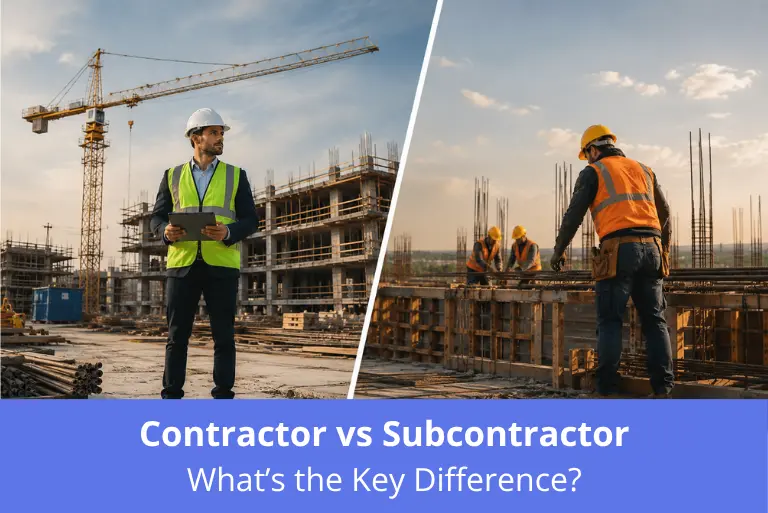
Contractors and subcontractors both carry out important work on construction projects, but their roles, responsibilities and contractual relationships are entirely different.
The main difference between a contractor and a subcontractor is who they work for and the scope of work they are responsible for. The client hires a contractor for an entire project or a significant scope of work. A subcontractor usually works for that contractor to complete a specific part of the work, such as electrical installation, plumbing, roofing or groundworks.
For example, a developer might hire a main contractor to build a new office, who then brings in subcontractors for electrical, mechanical, roofing and finishing work.
Understanding the difference helps clarify who manages the project, who carries out particular works, how responsibilities are divided and how payments and project costs move through the contractual chain.
Keep subcontractor costs, commitments, variations and payments organised across every project with LiveCosts.
Contractor vs Subcontractor at a Glance
The exact responsibilities depend on the project and contract, this table shows the typical differences between contractors and subcontractors in construction.

A simple way to picture this relationship.
The table below compares the typical roles and responsibilities of contractors and subcontractors.
Area | Contractor | Subcontractor |
Main role | Takes responsibility for delivering the overall project or a major scope of work for the client. | Carries out a specific package of work or specialist trade for the contractor. |
Who they work for | Usually works directly for the client or project owner under the main contract. | Usually works for the main or head contractor under a subcontract. |
What they deal with | Manages the overall project, including labour, materials, suppliers, subcontractors, costs and site activities. | Deals mainly with the labour, materials, plant and requirements needed to complete its particular package. |
Type of work | Oversees and coordinates multiple areas of construction rather than focusing on one specialist trade. | Typically carries out specialist work such as electrical, plumbing, roofing, groundworks, joinery or mechanical services. |
Day-to-day work | Plans works, coordinates trades, manages resources, monitors progress and costs, and deals with issues affecting the project. | Organises and completes its assigned work, manages its own operatives and materials, and coordinates with the contractor. |
Project management | Coordinates across projects and makes sure different packages of work come together correctly. | Manages its own scope of work, labour and resources to meet project requirements |
Subcontractors | May procure, appoint and manage several subcontractors for different packages. | May have its own workforce and, where permitted, may subcontract elements of its package further. |
Client relationship | Usually has the primary contractual relationship with the client for the construction works. | Usually reports to the contractor rather than having the main contractual relationship with the client. |
Scope of responsibility | Has broader responsibility for coordinating and delivering the contracted project. | Primarily responsible for completing its agreed subcontract works. |
Cost responsibilities | Manages project costs, including labour, materials, supplier orders, subcontract commitments and variations. | Manages the labour, materials, plant and other costs associated with delivering its own package. |
Variations | Manages changes that affect the project and may approve or adjust subcontracted work. | Identifies and prices changes affecting its package and submits variations where appropriate. |
Payment | Typically submits applications, claims or invoices to the client under the main contract. | Typically submits applications, claims or invoices to the contractor under the subcontract. |
Risk and accountability | Carries broader responsibility for project delivery, scheduling, coordination and costs. | Carries responsibility for successfully delivering its particular subcontract package. |
Example | General contractor manages the construction lifecycle of a new building. | Electrical, roofing and plumbing subcontractors complete individual packages within the project. |
What Is a Contractor?
A contractor is appointed under a contract to carry out construction work.
Project owners hire a general contractor for a construction project. Depending on the project, that could mean constructing an entire building, completing a refurbishment or delivering a significant part of a larger development.
The contractor does not necessarily carry out every activity using its own workforce. Instead, it may divide the project into separate packages and appoint specialist subcontractors to complete them.
For example, a contractor building a residential development might hire subcontractors for:
- Groundworks and drainage
- Structural works
- Roofing
- Plumbing
- Electrical installations
- Heating and ventilation
- Joinery
- Flooring
- Painting and decorating
The contractor then coordinates with different trades and makes sure their work stays on track.
What does a contractor do?
A contractor’s role generally involves much more than carrying out physical construction work.
Depending on the contract and project, contractors may deal with the construction project, labour, procurement, materials, suppliers, subcontractors, site coordination, project costs and changes to the works.
A contractor’s work can include tracking progress, arranging materials, coordinating trades, resolving site issues, reviewing subcontractor work and monitoring project costs.
A key part of the role is making sure different activities happen in the correct sequence.
For example, an electrical contractor needs to finish wiring before the walls are closed up. A flooring subcontractor may have to wait until other internal works are finished.
The main contractor needs to coordinate those dependencies so one package does not unnecessarily delay another.
This level of project responsibility is one of the main differences between a contractor and a subcontractor.
What Is a Subcontractor?
A subcontractor is hired by a contractor to complete a specific part of the work that the contractor has agreed to deliver.
Subcontractors are commonly used when a project requires specialist trades, skills or resources.
Rather than being responsible for the entire project, a subcontractor usually works to a defined scope or package of works.
For example, if a contractor is constructing a new apartment development, it might appoint an electrical subcontractor to complete the electrical installations and a roofing subcontractor to complete the roof.
Both businesses contribute to the same construction project, but their responsibilities are limited to their respective subcontract packages.
What does a subcontractor do?
A subcontractor carries out a specific part of the construction work, such as electrical, plumbing, roofing or groundworks.
Depending on the subcontract, this could involve supplying labour, organising materials, providing specialist equipment, supervising operatives and coordinating its activities with the contractor and other trades.
For example, an electrical subcontractor may schedule electricians, order cables and fittings, and plan installations around other work happening on site.
Subcontractors also need to communicate with the main contractor when something affects their work. If an area is not ready, materials are late or a design change alters the original scope, the subcontractor may need to raise the issue with the contractor.
While subcontractors manage their own work, they still need to coordinate with other trades and follow agreed project dates to keep the job moving.
See committed costs, variations and actual spend as subcontracted work in progress with LiveCosts.
How Do Contractors and Subcontractors Work Together?
Contractors and subcontractors need to coordinate closely because work completed by one trade can affect when another can start.
Consider the construction of a new hotel. The contractor may have groundworkers, structural steel contractors, roofers, electricians and mechanical trades working at different stages of the build. It coordinates their work so each trade can start when the site is ready and complete its work without holding up others.
For example, the roofing subcontractor may be due to start in week 15, but first, enough of the structure needs to be in place. If the structural work falls behind, the roofers may have to start later. This could then delay internal trades that need the building to be weather-tight before they can begin.
Subcontractors focus on completing their own work, while the contractor keeps track of how each trade affects the next stage of the build. Clear communication between both sides helps resolve delays, changes and site issues before they affect other work.
Key Differences Between Contractors and Subcontractors
The distinction between contractors and subcontractors becomes clearer when looking at their contractual, operational and financial responsibilities.
Who hires them?
A main contractor is generally appointed by the client or project owner.
A subcontractor is generally appointed by the contractor.
For example, if a property developer appoints a construction company to deliver a new warehouse, that company acts as the general contractor.
If the construction company appoints another business to complete the electrical installation, that business is acting as an electrical subcontractor.
Who appoints the business therefore helps determine where it sits in the contractual chain.
Scope of work
Contractors generally have a broader scope of responsibility.
A contractor might be responsible for delivering the entire construction phase of a project, requiring it to coordinate many different trades, suppliers and activities.
A subcontractor usually has a more specific scope.
An electrical subcontractor may only be responsible for the electrical works, while a groundworks subcontractor may be responsible for excavation, drainage and other agreed groundwork.
This specialist focus allows contractors to bring different skills and resources into a project without directly employing every trade required.
Daily responsibilities
Contractors generally focus on managing the project as a whole.
Their responsibilities may include coordinating subcontractors, checking progress, procuring materials, managing suppliers, reviewing costs, dealing with variations and resolving problems affecting the project.
Subcontractors concentrate more closely on delivering their assigned works.
They may manage their own labour, materials, equipment and work schedule while communicating progress and issues to the contractor.
Both roles involve management, but they operate at different levels of the project.
Contracts
Both client and contractor operate under a construction contract.
The contractor and subcontractor operate under a separate subcontract.
The subcontract defines the work to be completed and covers areas such as scope, price, timelines, payment terms and variations.
Contractual arrangements differ between projects and jurisdictions, so the actual contract should always be used to determine each party’s responsibilities.
Payment
Payment also generally follows the contractual chain.
The contractor seeks payment from the client according to the main contract. Subcontractors seek payment from the contractor according to their respective subcontract agreements.
Depending on the project and market, payments may involve invoices, applications, progress claims or valuations.
This means a contractor managing several subcontractors may need to track numerous financial commitments at the same time.
It needs to know what has been agreed with each subcontractor, what work has been completed, what has been claimed or invoiced and what costs are still outstanding.
Variations
Changes to construction work can affect both contractors and subcontractors.
A client might request additional work or a design change could alter what was originally planned.
The general contractor needs to assess how the change affects project costs, timelines and other work on site.
If the change affects a subcontracted package, the subcontractor also needs to determine what additional labour, materials or time may be required.
For example, if additional lighting is added to a project, the electrical subcontractor may submit a variation for the additional work. The main contractor then needs to account for that change in the project’s overall costs.
Responsibility and risk
The contractor generally carries broader responsibility because it has agreed to deliver a larger scope to the client.
It must coordinate labour, materials, suppliers, subcontractors and costs across the project.
A subcontractor has more focused responsibility for its own package.
That does not mean subcontractors carry little risk. Problems with labour, materials, productivity, quality or delays can affect whether they complete their work on time and within budget.
The important distinction is therefore not simply who has more responsibility, but what each party is responsible for.
Can a Contractor Also Be a Subcontractor?
Yes. A construction business can act as a contractor on one project and a subcontractor on another.
The terms describe the business’s role within a particular contractual arrangement rather than permanently defining what type of company it is.
For example, a property owner can directly hire a roofing company to replace its warehouse roof. In that arrangement, it acts as the contractor.
The same roofing company could later be hired by a contractor to complete the roofing package on a new commercial development. On that project, it is acting as a subcontractor.
To understand a business’s role, look at its position in the project, its contractual relationship and the work it is responsible for delivering.
Track labour, materials, suppliers and subcontractor costs against your project budget using LiveCosts.
General Contractor vs Head Contractor
Terminology can vary between construction markets.
General contractor is widely used in markets such as the UK and Ireland for the contractor appointed to deliver the main construction works.
In Australia, the term head contractor is also commonly used.
Regardless of the terminology, the general distinction remains similar: the main or head contractor manages a broader construction scope, while subcontractors carry out specific areas of work.
The exact responsibilities should always be determined by the project’s contractual arrangements and applicable local requirements.
Managing Subcontractor Costs
Managing subcontractors is not only about coordinating work on site. Contractors also need to understand how subcontract packages affect project costs.
A contractor might agree to a subcontract value before the subcontractor completes the work or submits all invoices.
For example, if a contractor agrees to a £100,000 subcontract package but has only received £40,000 in invoices so far, looking at invoices alone does not provide the complete cost picture. The remaining subcontract value still represents a financial commitment, subject to the subcontract terms and any subsequent changes.
Variations can change that position further.
Contractors therefore need visibility over areas such as:
- Original subcontract values
- Committed costs
- Purchase orders
- Variations
- Applications or invoices
- Actual costs
- Remaining costs and project budgets
Construction cost management software such as LiveCosts can help contractors keep subcontract commitments, purchase orders, job costing, variations and actual project costs connected to the relevant job.
This gives project and commercial teams a clearer view of costs as work progresses rather than relying only on invoices that have already reached the accounts.
Frequently Asked Questions
Why do contractors use subcontractors?
Contractors often use subcontractors to access specialist skills, labour or equipment for particular packages of work, such as electrical, mechanical, roofing or groundworks.
Who pays subcontractors?
Subcontractors are usually paid by the main or head contractor, not the client. They typically submit an application for payment, progress claim or invoice based on work completed.
Who is responsible for materials: the contractor or subcontractor?
It depends on the agreed scope. A subcontractor may supply the materials needed for its job, or the contractor may procure certain materials directly. The contract or subcontract should make these responsibilities clear.
Can a contractor work as a subcontractor on another project?
Yes. A construction firm can work as a contractor on one project and a subcontractor on another. Its role depends on its position within the contractual arrangement and the scope it has agreed to deliver.
Who manages the entire construction project?
General contractor typically manages the overall project. Subcontractors manage their own tasks and resources around the agreed schedule and coordinate with other trades to keep their part of the project on track.
Can a contractor have multiple subcontractors?
Yes. It is common for contractors to appoint multiple subcontractors, particularly on larger projects. One project could have separate subcontractors for groundworks, structural works, electrical installation, plumbing, mechanical services, roofing and internal finishes.
Are all tradespeople considered as subcontractors?
No. A tradesperson can be directly employed by a contractor or work for a subcontracting company. Being an electrician, plumber, roofer or another specialist trade does not automatically make them a subcontractor; it depends on how they are contracted.
Contractor vs Subcontractor: The Wrap-Up
Contractors and subcontractors are two different but closely connected roles in getting construction work completed. The contractor oversees the project, coordinates trades, manages resources and keeps track of costs, while subcontractors focus on completing their agreed work to the required standard and timescale.
The relationship also affects how contracts, payments and responsibilities are handled throughout the job. Contractors deal with the client and manage multiple areas of work, while subcontractors work alongside other trades and report progress, changes or issues that could affect the build.
Understanding the differences between these roles makes it easier to identify who is responsible for what, how trades coordinate on site, and who handles payments throughout the project.
