
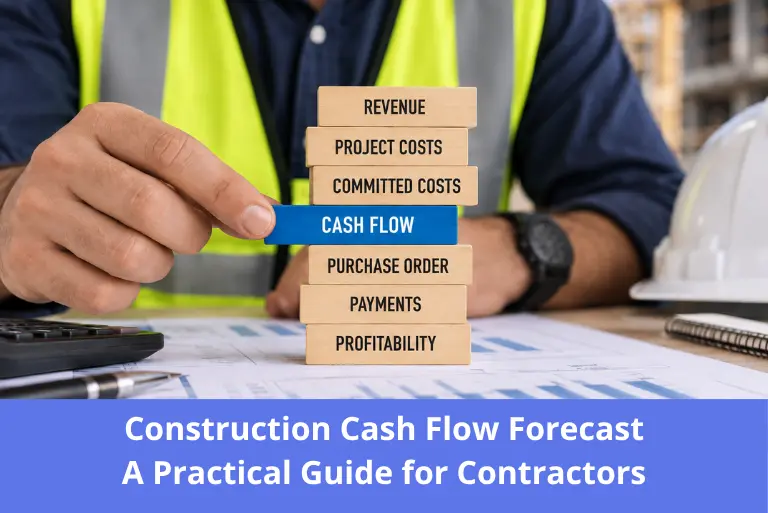
A construction cash flow forecast estimates the amount and timing of money expected to enter and leave a construction project over a specific period. It helps contractors understand their future cash position, identify potential shortfalls, and prepare for upcoming project payments.
Construction companies often pay for labour, materials and subcontractors before receiving payment from the client. A project can therefore remain profitable overall while creating periods of negative cash flow.
Cash Flow Forecasting calculation is pretty simple:
Opening Cash + (Cash Inflows − Cash Outflows) = Closing Cash Position
The challenge is predicting the amounts and, more importantly, when each payment will occur.
What Is a Construction Cash Flow Forecast?
A construction cash flow forecast estimates the timing and value of future cash receipts and payments on a construction project.
It shows how the cash position may change from week to week or month to month as work progresses. Contractors can use this information to see when project expenditure may exceed incoming cash and prepare for those periods in advance.
Unlike a static financial plan, a cash flow forecast needs regular updates. Payment dates change, project costs move, and variations can alter expected income or expenditure.
Why Is Cash Flow Forecasting Important in Construction?
Cash flow forecasting helps contractors identify periods when they may not have enough available cash to cover project payments.
Construction creates a particular cash flow challenge because the timing of income and expenditure rarely matches. A contractor may need to purchase materials, pay employees and settle subcontractor accounts weeks before receiving the related client payment.
A reliable forecast helps the business anticipate these gaps and understand how much cash a project may require at different stages.
It can also help management:
- Prepare for upcoming project payments
- Identify potential cash shortages earlier
- Understand future funding requirements
- Plan expenditure around expected receipts
- Make financial decisions using expected rather than historical cash positions.
The objective is not simply to know how much the project will spend. Contractors need to understand when that spending will affect available cash.
LiveCosts brings project income, costs and commitments together, giving you a clearer view of your current and future cash position.
What Goes Into a Construction Cash Flow Forecast?
A construction cash flow forecast combines the opening cash position with expected cash inflows and outflows during each forecasting period.
Opening Cash Balance
The opening balance represents the cash available at the beginning of the forecast period. It provides the starting point for calculating the future cash position.
Expected Cash Inflows
Cash inflows are payments the contractor expects to receive.
Depending on the project, these can include client payments, advance payments, progress payments, variation payments and retention releases.
The expected receipt date matters as much as the value. An invoice raised in April does not improve the April cash position if the client is expected to pay in May.
Expected Cash Outflows
Cash outflows represent money expected to leave the business.
Typical construction outflows include labour, materials, subcontractors, plant, equipment and other project expenses.
A reliable project budget provides an important starting point for identifying expected expenditure. As the project develops, current cost information can make these assumptions more accurate.
This is where construction budgeting software can help teams maintain a clearer view of project budgets and changing costs as work progresses.
Expected Payment Dates
Every forecast receipt and payment needs a realistic date.
Contractors should use the period when they expect cash to move rather than relying only on invoice dates or the date work takes place.
This timing turns a list of expected income and expenditure into a usable cash flow forecast.
How to Create a Cash Flow Forecast?
Creating a cash flow forecast involves estimating future income and expenses, setting realistic payment dates, and calculating how much cash will be available.
1. Choose the Forecast Period
Start by deciding how far ahead the business needs to forecast.
Weekly forecasts provide detailed short-term visibility. Monthly forecasts provide a broader view across longer construction projects.
The right period depends on the project duration and how closely the business needs to monitor available cash.
2. Establish the Opening Cash Position
Record the amount of cash available at the start of the first period.
This balance becomes the foundation for the remaining forecast calculations.
3. Forecast Expected Cash Inflows
List the payments expected from clients and other project income sources.
For each expected receipt, record the amount and realistic payment date. Consider contract payment terms and known delays rather than assuming clients will pay immediately.
4. Forecast Expected Cash Outflows
List the project payments expected during the same period.
Use current information about labour, materials, subcontractors and other costs. Known commitments can also help identify expenditure that has not yet appeared as an invoice.
For example, an approved purchase order may create a future payment requirement even though the supplier has not submitted the final invoice.
5. Calculate Net Cash Flow
Calculate the difference between incoming and outgoing cash for each period.
Cash inflows minus cash outflows equals net cash flow.
If a project receives £40,000 during a month and pays out £55,000, its net cash flow for that period is negative £15,000.
6. Calculate the Closing Cash Position
Add the net cash movement to the opening cash balance to determine the closing cash position.
If the opening balance is £30,000 and net cash flow is negative £13,500, the closing cash position is £16,500.
That closing amount then becomes the opening balance for the next period.
7. Identify Potential Cash Shortfalls
Review periods where the forecast balance becomes negative or falls unusually low.
These periods show where expected expenditure may place pressure on available cash.
Identifying the gap several weeks in advance allows the team to understand the cause and prepare for it.
8. Update the Forecast
A construction cash flow forecast should change as new project information becomes available.
Update it when client payment dates move, costs change, project progress differs from the programme or variations affect expected receipts and expenditure.
Regular updates keep the forecast connected to the project’s current financial position.
LiveCosts keeps committed and actual costs visible, helping you understand upcoming cash requirements before invoices arrive.
Project Cash Flow Forecast Example
Consider a contractor starting in April with 50,000 £ available.
| Month | Opening Cash | Cash In | Cash Out | Net Cash Flow | Closing Cash |
| April | £50,000 | £30,000 | £45,000 | £15,000 negative | £35,000 |
| May | £35,000 | £20,000 | £50,000 | £30,000 negative | £5,000 |
| June | £5,000 | £60,000 | £35,000 | £25,000 | £30,000 |
The forecast shows that the project remains cash positive, but May creates significant pressure. Only 5,000 £ remains before the larger client receipt arrives in June.
Without forecasting, management may not recognise this exposure until payments become due.
How Far Ahead Should You Forecast Cash Flow?
Contractors should forecast far enough ahead to identify cash requirements while the underlying assumptions remain useful.
A weekly forecast can support immediate payment planning. A rolling 13-week forecast provides a wider view of near-term liquidity, while monthly forecasts suit longer project periods.
Some contractors also forecast across the full project lifecycle to understand how cash requirements may change as construction progresses.
The forecasting horizon should match the financial decisions the business needs to make.
What Causes Negative Cash Flow on a Project?
Negative cash flow occurs when more money leaves a project than comes in during the same period. Delayed payments can make this particularly difficult in construction, where contractors often need to cover project costs before receiving payment.
The scale of this pressure is significant. A recent Menzies report found that 86% of construction firms were already in or at risk of serious financial distress. It also found that 93% had experienced late payments, which were 53 days overdue on average. One in five firms were financing their own projects while waiting to be paid.
Other causes include large material purchases, subcontractor payments, retention, project delays, variations, and unexpected increases in costs.
For example, a contractor may need to pay £70,000 to suppliers and subcontractors this month but receive the related £90,000 client payment next month. The project may remain profitable overall, but its cash flow is negative during the current period.
Can a Profitable Job Still Run Short of Cash?
Profit measures financial performance, while cash flow measures the availability and movement of cash.
For example, a project with £500,000 in expected revenue and £420,000 in expected costs would generate an estimated profit of £80,000.
However, the contractor may need to pay £150,000 before receiving the next £100,000 client payment.
The project can therefore remain profitable while temporarily requiring additional cash to continue operating.
This is why contractors should not use expected project profit as a substitute for cash flow forecasting.
Cash Flow Forecast vs Project Budget in Construction
A project budget and cash flow forecast answer different financial questions.
| Project Budget | Cash Flow Forecast |
|---|---|
| Shows expected project income and costs | Shows when cash is expected to move |
| Focuses on financial amounts | Focuses on amounts and timing |
| Measures performance against planned values | Predicts future cash availability |
| Provides a financial baseline | Changes as payment expectations change |
A budget might show £120,000 of expected material costs. The cash flow forecast determines whether those payments are expected in April, May, June or another period.
The budget therefore provides important financial information, while the forecast adds the timing needed for cash planning.
LiveCosts gives you an intuitive view of project costs and expected income, helping you plan ahead and maintain healthier cash flow.
What Makes a Cash Flow Forecasting Inaccurate?
Forecasts become less reliable when the assumptions no longer reflect current project conditions.
Common problems include outdated client payment dates, missing costs, incorrect supplier payment dates, unrecorded variations, and overly optimistic assumptions about when money will arrive.
Missing commitments can also skew forecasts. A purchase order can be for future expenditure even if the supplier invoice has not yet arrived in the accounts team.
Forecast accuracy therefore depends heavily on current project information.
How Can Contractors Improve Cash Flow Forecast Accuracy?
Contractors can improve forecast accuracy by using realistic payment dates and keeping the underlying project financial information current.
Start by reviewing expected receipts against actual contract terms and recent client payment behaviour. Then review known project expenditure, including costs that have already been committed but not yet invoiced.
Compare forecast movements with what actually happened. Differences can reveal assumptions that need adjusting in future periods.
Most importantly, forecast when material project information changes rather than waiting for a fixed monthly reporting date.
When Should You Move Beyond Spreadsheets?
Spreadsheets become harder to maintain when contractors manage several projects with constantly changing costs and payment dates.
A spreadsheet may work well when one person manages a small number of predictable transactions. The process becomes more difficult when teams need to reconcile budgets, supplier commitments, invoices, labour costs and project changes from several sources.
The problem is not the spreadsheet calculation itself. The challenge is keeping the information behind that calculation current.
How Does LiveCosts Provide Better Cash Flow Visibility?
LiveCosts gives contractors and teams a current view of the financial activity that can affect project cash flow.
The Project dashboard brings together income, actual costs, committed costs, remaining budgets, and outstanding spend. Main contractors can review these figures across active projects or look at individual projects in more detail.
Cost charts show how spending changes over time, while open purchase orders highlight costs that have been committed but may not yet have been invoiced. Labour costs and billed and unbilled income add further context to the project’s financial position.
By keeping this information current, LiveCosts helps contractors understand what has already been spent, what is still committed, and where future cash requirements may arise.
Construction Cash Flow Forecast Checklist
Before building a forecast, confirm the forecast period, opening cash balance, and current project financial information.
Then:
- List expected cash receipts
- Record expected payment dates
- Identify upcoming project expenditures
- Include known future commitments
- Assign each payment to the appropriate period
- Calculate net cash flow
- Calculate the closing cash position
- Identify periods of low or negative cash
- Update assumptions when project conditions change
- Compare forecasts with actual cash movement
A useful construction cash flow forecast should show not only how much money a project expects to receive and spend but also when those movements are likely to affect available cash.
Frequently Asked Questions
What is a cash flow forecast in construction?
A cash flow forecast in construction estimates how much money is expected to come into and go out of a project and when those payments are likely to occur.
How do you calculate construction cash flow?
Subtract expected cash outflows from expected cash inflows to calculate net cash flow. Add the result to the opening cash balance to calculate the expected closing cash position.
When should you update a cash flow forecast?
Update the forecast when project costs, expected income, or payment dates change. Regular updates help keep the forecast aligned with the project's current financial position.
Can You Forecast Cash Flow in Excel?
Yes. Excel can calculate construction cash flow using expected receipts, payments, and dates. However, maintaining accurate forecasts becomes more difficult when financial information changes frequently across multiple live projects.
What Should You Include in a Cash Flow Forecast?
It should include the opening cash balance, expected client receipts, project payments, realistic payment dates, net cash movement and expected closing cash position for each period.
Can a profitable project have negative cash flow?
Yes. A profitable project can experience negative cash flow when suppliers, employees and subcontractors need payment before the contractor receives the related client income.

