
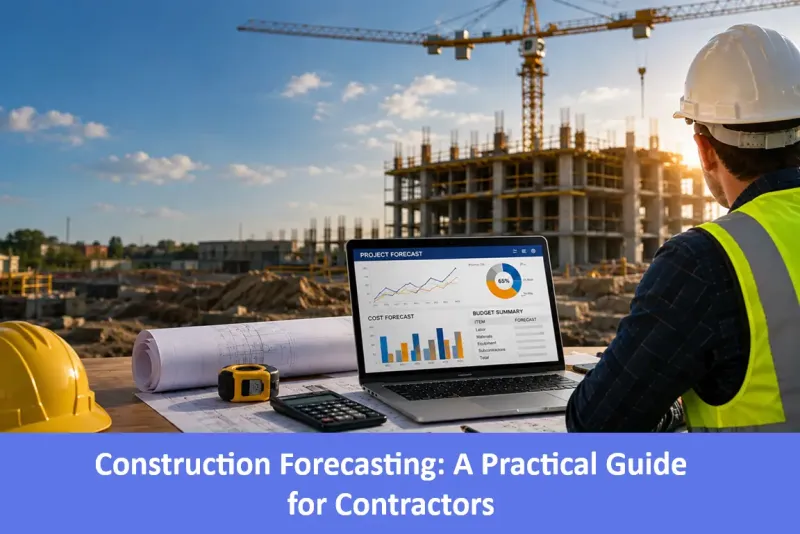
Construction forecasting matters more today than ever before. Material prices shift quickly with the CSO Wholesale Price Index for Building and Construction Materials reporting an increase of 129 in April to 131 in May with costs set to rise. Labour costs have also increased from 32.62 to 33.39 according to the CSO. Margins on many projects are thin and Contractors who do not forecast often discover margin problems too late into a job
Many contractors face the same issues. Costs get lost in spreadsheets that fall out of date within days. Invoices arrive late. Budgets and actual spends are never joined up. By the time anyone sees the full picture, the project has already moved past the point where action could help.
This guide explains construction forecasting in plain terms. You will learn what it actually is, how it differs from budgeting and estimating, and why so many forecasts go wrong. You will also learn the steps involved in building a reliable forecast, the best practices that improve accuracy, and how the right software and live cost data can make the whole process far more dependable.
By the end, you should have a clear, practical understanding of how to forecast construction projects with more confidence and fewer surprises.
What Is Construction Forecasting?
Construction forecasting is the process of predicting a project’s future costs, cash flow, schedule, and resource needs. It uses real data from the project so far, combined with market trends and planning assumptions, to estimate what is still to come.
In simple terms, a budget tells you what you planned to spend. A forecast tells you what you are actually likely to spend by the time the project ends.
Forecasting is not a one-time task. It is continuous. A forecast created in month one will look different from a forecast created in month six, because more real data is available by then. Good forecasting teams update their numbers regularly, not just once at the start.
Real World Example:
Imagine a contractor building a small commercial unit. The original budget for groundworks was fifty thousand pounds. Three months in, actual spend on groundworks reaches forty thousand pounds, but only 70% of that work is complete.
A simple budget would not flag this as a problem since the spend is still under the line item total. A forecast would. It would recalculate the likely final cost based on current progress and show that groundworks are now tracking towards sixty thousand pounds, ten thousand over budget. That early warning gives the contractor time to act, rather than discovering the overrun at project close.
Types of Construction Forecasting:
Cost forecasting predicts the total cost of a project at completion. It matters because it shows whether the project will finish within budget, while there is still time to make changes.
Cash flow forecasting predicts money moving in and out of the business over time. It matters because a project can be profitable on paper and still run into serious trouble if cash runs short at the wrong moment.
Schedule forecasting predicts whether the project will finish on time. It matters because delays often carry direct financial penalties and damage client relationships.
Resource forecasting predicts the labour, equipment, and materials needed in the weeks ahead. It matters because it helps avoid both shortages that cause delays and excess resources that waste money.
Why Construction Forecasting Matters?
Construction forecasting is not just a reporting exercise. It directly affects whether a project stays profitable and whether a business stays healthy.
Cost control: Forecasting shows whether spending is tracking towards the original budget or drifting away from it. This visibility allows teams to correct course before small overruns become large ones.
Cash flow: Many construction businesses run several projects at once, each at a different stage of payment. Forecasting helps ensure there is enough cash on hand to cover wages, materials, and subcontractors, even when client payments are delayed.
Resource planning: Knowing what is likely to happen next allows teams to plan labour and material needs in advance. This reduces last-minute scrambling and avoids paying premium rates for rushed deliveries or temporary labour.
Profit protection: Margins in construction are often slim. A forecast that flags a problem early gives a project enough time to recover lost margin. A forecast that arrives too late simply confirms the loss after it has already happened.
Early decision-making: Perhaps the biggest benefit is time. Forecasting turns financial management from a reactive task into a proactive one. Project managers can make informed decisions while there are still options available, rather than explaining after the fact why a project went over budget.
Together, these benefits explain why forecasting has become a core part of construction project management, not an optional extra.
See how contractors gain stronger control over job costing, budgets, POs, invoices, and project costs.
Construction Forecasting vs Budgeting vs Estimating
These three terms are often used loosely, but they mean different things. Understanding the difference helps teams use each one properly.
| Estimating | Budgeting | Forecasting |
| Happens before the project starts | Happens at the start of the project | Happens continuously during the project |
| Predicts likely costs based on scope and market rates | Sets the approved spending plan for the project | Predicts the likely final outcome based on actual progress |
| Used to win the work and set client pricing | Used to control and allocate funds | Used to manage risk and guide decisions in real time |
| Based on assumptions and historical data | Based on the agreed estimate | Based on real, current project data |
| A single, fixed figure | A fixed plan, rarely changed once approved | A moving figure, updated regularly |
In short, an estimate predicts what a project should cost. A budget sets what the project is allowed to spend. A forecast tells you what the project is actually on track to cost, based on what is really happening on site.
How Does Construction Forecasting Work?
Building a reliable forecast follows a fairly consistent process, regardless of project size.
- Start with the project estimate: This sets the initial expectation for cost, scope, and timeline before work begins.
- Build the budget: The estimate is turned into an approved budget, broken down by cost code or work category.
- Track actual costs: As work progresses, every cost is recorded against the relevant budget line. This includes labour, materials, subcontractors, and equipment.
- Compare budget vs actual: Regular comparison shows where spending is on track and where it has started to drift.
- Forecast remaining costs: Using current performance, the team estimates the cost to complete the remaining work. Added to costs already spent, this gives the projected final cost.
- Update continuously: As more real data comes in, the forecast is recalculated. This keeps it accurate and useful, rather than letting it fall out of date.
This cycle repeats throughout the life of the project, becoming more accurate as more real data becomes available.
Why Does Manual Forecasting Create Blind Spots?
Many contractors still forecast manually, often through spreadsheets. This approach creates several common blind spots.
Incomplete cost data: If costs are recorded in different places by different people, no single forecast can ever see the full picture.
Spreadsheet errors: A single incorrect formula or accidental overwrite can quietly distort an entire forecast without anyone noticing.
Delayed invoice processing: If invoices take weeks to reach the finance team, the forecast is always working with old information.
Scope changes: When scope changes are not recorded properly, the forecast keeps comparing actual spend against an outdated budget.
Material price fluctuations: Manual forecasts often use fixed material prices, even when market prices have moved significantly since the budget was set.
Poor communication: When site teams and finance teams do not share information regularly, forecasts end up based on assumptions rather than current reality.
Each of these issues seems small on its own. Together, they explain why so many manual forecasts turn out to be wrong by the time a project closes.
Best Practices for Better Construction Forecasting
A few consistent habits make the biggest difference to forecasting accuracy.
- Update forecasts regularly: Weekly or monthly updates keep the forecast aligned with what is actually happening on site.
- Use live cost data: Forecasts built on current data are far more reliable than those built on numbers that are days or weeks old.
- Review committed costs: Purchase orders and signed contracts represent money that will be spent, even if it has not been invoiced yet. These need to be included, not just actual invoices received.
- Include approved variations: Scope changes need to be reflected in the forecast immediately, not added in retrospectively at the end.
- Standardise cost codes: Using the same cost codes across every project makes it far easier to compare performance and spot patterns.
- Monitor budget variance: Regularly reviewing the gap between budget and actual spend helps catch problems while they are still small.
- Connect finance with site teams: Forecasts are only as accurate as the information feeding into them. Regular communication between office and site closes this gap.
How Construction Forecasting Software Helps?
Software has become a natural part of modern construction forecasting, mainly because it solves the data problems that make manual forecasting unreliable.
Good construction forecasting software keeps live project costs visible in one place, rather than scattered across spreadsheets and email threads. It tracks purchase orders as they are raised, so committed costs are visible before an invoice ever arrives. It captures supplier invoices as they come in, reducing the delay between a cost being incurred and it appearing in the forecast.
It also supports ongoing budget tracking, comparing actual and committed spend against the approved budget in real time. Reporting becomes far simpler too, since teams can generate up-to-date forecasts without manually pulling numbers from several sources.
Many of these tools also connect with accounting systems, so financial data does not need to be entered twice. This reduces errors and saves significant time for finance and project teams alike.
The result is a forecasting process built on current, connected data, rather than numbers that are already out of date by the time anyone looks at them.
How Does LiveCosts Improve Forecasting Accuracy?
Many tools are good at reporting what has already happened. They show last month’s spend, last week’s invoices, or last quarter’s totals. That is useful, but it is history, not forecasting.
Forecasting requires knowing what is likely to happen next. That means seeing committed costs before they are invoiced, catching budget drift while it is still small, and understanding how current site activity will affect the final project outcome.
LiveCosts keeps project costs, commitments, invoices, and budgets connected in one place. As POs are raised and invoices come in, the forecast updates automatically, rather than waiting for someone to manually update a spreadsheet. This keeps the forecast grounded in what is actually happening on the project, not what happened weeks ago.
By connecting these pieces together, LiveCosts helps project teams build forecasts they can actually trust and gives them time to act on problems while there is still room to change the outcome.
Common Questions People Ask
What is the difference between estimation and forecasting?
An estimate is set before the project starts. A forecast is updated during the project, based on actual progress and current data.
What is the difference between forecasting and budgeting?
A budget is the approved spending plan set at the start of a project. A forecast is updated continuously and predicts the likely final outcome based on actual progress.
How often should a construction forecast be updated?
Most teams update forecasts weekly or monthly, with extra updates after any major change in scope, cost, or schedule.
Which forecasting method is most accurate?
The bottom up method tends to be the most accurate since it forecasts each cost category individually. It does take more time and data than simpler methods.
Can small construction firms benefit from forecasting?
Yes. Even simple projects benefit from basic cost and cash flow forecasting. It helps avoid running short on funds and supports better client communication.
What software is used for construction forecasting?
Construction job software tracks live project costs, purchase orders, supplier invoices, and budget variance in one place. Tools such as LiveCosts are built for this, giving a more accurate, real-time forecast.

