
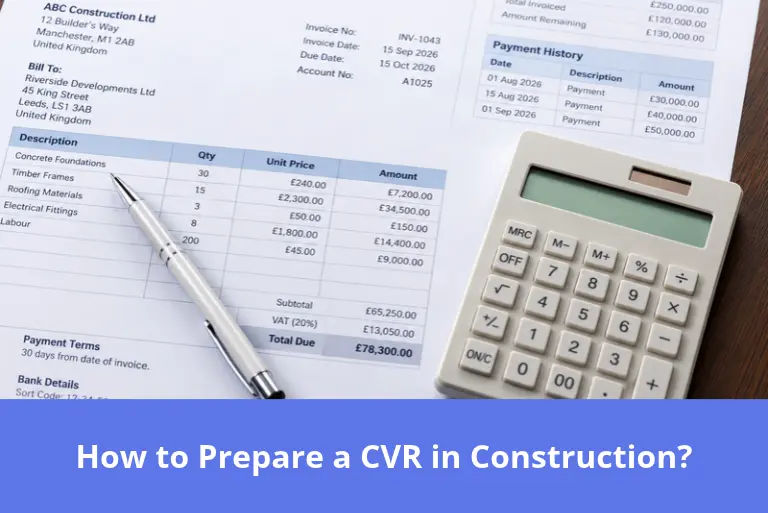
A cost value reconciliation, or CVR, compares the value of completed work with the cost of delivering it. Contractors use it to understand current profit, forecast final cost, track margin, and identify financial risk before it affects the project.
To prepare a CVR, confirm the contract value, record actual and committed costs, estimate the cost to complete, and compare the latest position with the previous reporting period.
A successful CVR should answer three simple questions:
- What value has the project earned?
- What has the project cost so far?
- What will the project cost upon completion?
The quality of the CVR depends on the quality of the data behind those answers.
What Is a CVR in Construction?
A CVR is a commercial report that compares project value with project cost.
Contractors usually prepare CVRs each month to track financial performance throughout the project.
The report brings together contract value, variations, actual costs, committed costs, accruals and future cost forecasts. It then shows the expected final profit and margin.
A CVR helps commercial teams move beyond historical accounting data. It gives them a clearer view of where the project stands now and where it is likely to finish.
For example, a project may appear profitable based on invoices received so far. However, large purchase orders, subcontract commitments or labour costs may still sit outside the accounts.
A CVR brings those costs into the project forecast.
What Do You Need Before Preparing a CVR?
Before you start, gather the main commercial and cost information for the job.
You will usually need:
- Original contract value
- Approved variations
- Value of work completed.
- Supplier invoices
- Subcontractor costs
- Labour costs
- Plant and material costs
- Purchase orders
- Other committed costs
- Accruals
- Remaining work
- Previous CVR figures
The aim is to create one accurate financial view of the project.
If cost information sits across spreadsheets, accounting software, purchase orders and site records, reconcile those sources before finalising the CVR.
How to Prepare a CVR Step by Step
1. Confirm Contract Value and Variations
Start with the original contract value.
Then add approved variations and any other agreed adjustments that change the expected final value of the project.
This gives you the latest forecast value.
For example:
Original contract value: £1,000,000
Approved variations: £80,000
Forecast final value: £1,080,000
Please keep approved changes separate from unapproved changes. This makes the report easier to review and reduces the risk of overstating project value.
2. Record Actual and Committed Costs
Next, record the costs the project has already incurred.
These may include:
- Supplier invoices
- Subcontractor applications
- Labour
- Materials
- Plant
- Preliminaries
Then add committed costs.
Committed costs include orders or agreements that the business has approved but has not yet fully paid.
Examples include open purchase orders and subcontract packages.
These commitments matter because accounting records may not reflect the project’s full cost exposure.
You should also include accruals for work completed where the invoice has not yet arrived. Commitments and accruals give you a more accurate view of the project’s true cost position.
3. Estimate the Cost to Complete
Cost to complete is the estimated cost of all work that remains on the project. Review the work left to complete and estimate the cost of each package, phase or cost code.
Do not simply subtract current spending from the original budget.
Instead, ask:
- What work remains?
- What has already been ordered?
- Have supplier prices changed?
- Do any labour costs look higher than expected?
- Are there unresolved variations or risks?
- Will any package exceed its original allowance?
This step turns the CVR into a forecast rather than a record of past spending.
4. Calculate Forecast Cost, Profit and Margin
Once you know the cost to date and the cost to complete, calculate the expected final cost.
Use this formula:
Forecast final cost = cost to date + cost to complete
Then calculate forecast profit:
Forecast profit = forecast final value minus forecast final cost.
You can then calculate the forecast margin:
Forecast margin = forecast profit divided by forecast final value multiplied by 100
For example:
- Forecast final value: £1,080,000
- Forecast final cost: £960,000
- Forecast profit: £120,000
- Forecast margin: 11.1 per cent
These figures show the project’s expected financial outcome based on the current forecast.
5. Compare the Current CVR with the Previous Period
A CVR becomes more useful when you compare the latest figures with the previous period.
Look for changes in:
- Contract value
- Forecast final cost
- Cost to complete
- Profit
- Margin
- Major cost packages
The movement matters as much as the final number.
For example, a project may still show a profit, but the margin may have fallen from 12 per cent to 8 per cent in one month.
That change needs an explanation.
Commercial teams should review the cause and decide whether to adjust procurement, labour, pricing or project delivery.
CVR Calculation Example
For example, a project may have the following CVR figures:
Item Amount: Original contract value £800,000 Approved variations: £50,000 Forecast final value: £850,000 Actual costs to date: £500,000 Remaining forecast cost: £260,000 Forecast final cost: £760,000 Forecast profit: £90,000 Forecast margin: 10.6 per cent
The project currently forecasts a profit of £90,000.
However, the commercial team should still compare this result with the previous CVR and review any major movement in cost or value.
A single margin figure does not explain project performance on its own.
What Should a CVR Report Include?
A useful CVR report should have enough detail to explain the financial position without making it difficult to review.
Most reports should include:
- Original contract value
- Approved variations
- Forecast final value
- Budget
- Actual cost to date
- Committed cost
- Accruals
- Cost to complete
- Forecast final cost
- Forecast profit
- Forecast margin
- Previous period figures
- Variance or movement
Larger contractors may also break the report down by phase, package or cost code.
This helps teams identify where overspending starts and which parts of the project need attention.
Common CVR Mistakes That Affect Profit:
Relying on accounting data
Accounting software records financial transactions, but invoices often arrive after the cost has already occurred.
Include commitments and accruals to avoid understating project cost.
Ignoring open purchase orders
An open purchase order still represents expected spend.
If you leave it out, the project may appear to have more budget available than it actually does.
Treat the original budget as the forecast.
A budget shows the original plan.
A forecast should reflect what you now expect to happen.
Update remaining costs when prices, labour, scope or project conditions change.
Failing to explain margin movement
A falling margin should always have a reason.
Review which cost packages or value changes caused the movement.
Updating the CVR too late
A CVR has less value if teams update cost information by month-end.
Keep project costs current throughout the reporting period so the commercial review starts with accurate data.
How Often Should You Prepare a CVR?
Most contractors prepare CVRs monthly.
A monthly cycle gives commercial and finance teams enough time to review cost movement, update forecasts and act before problems grow larger.
Some businesses also review high-risk projects more frequently.
The best frequency depends on project size, complexity and financial exposure.
The key point is consistency. Prepare the CVR on the same basis each period so you can track movement accurately.
How LiveCosts Supports CVR Reporting?
LiveCosts helps UK contractors keep the cost data behind each CVR accurate and up to date.
It centralises purchase orders, invoices, labour and project costs, while showing live commitments against budget. Commercial teams can see actual costs, committed spend, remaining budget and project margin without pulling figures from multiple systems.
LiveCosts also supports UK construction workflows, including CIS, helping contractors manage project costs alongside local tax and accounting requirements.
With centralise current cost and commitment data, teams can prepare CVRs with less manual reconciliation and build more reliable forecasts for final cost and margin.
FAQs
Who prepares a CVR in construction?
Quantity surveyors and commercial managers usually prepare the CVR. Project managers, finance teams and directors may also review the report before final approval.
What costs should be included in a CVR?
A CVR should include actual costs, committed costs, accruals and the forecast cost of remaining work. Typical costs include labour, materials, plant, subcontractors and preliminaries.
What is the difference between CVR and WIP?
CVR compares project value with cost and forecasts the project’s expected financial outcome. WIP focuses on the accounting treatment of work completed but not yet fully invoiced or recognised.
How do you calculate CVR profit?
Subtract the forecast final cost from the forecast final value.
Forecast profit = forecast final value minus forecast final cost.
Can you prepare a CVR in Excel?
Yes. Many contractors use Excel to prepare CVRs. However, the process becomes harder to manage when project data sits across several spreadsheets, purchase orders, accounting systems and site records.

