Construction bookkeeping is the process of recording and organising a construction company’s financial transactions while keeping relevant income and costs connected to individual projects. It covers everyday financial records such as supplier invoices, subcontractor payments, labour costs, customer invoices and bank transactions. For UK contractors, bookkeeping can also involve construction-specific requirements and contract processes such as CIS, Domestic Reverse Charge VAT, applications for payment and retention.
What makes construction bookkeeping different is the need for project-level detail.
Knowing that the business spent £10,000 on materials is useful for the accounts. A contractor also needs to know which project used those materials, which cost code they belong to and how that expenditure affects the job.
This is why effective construction bookkeeping increasingly depends on connecting accounting records with project cost information.
What Is Construction Bookkeeping?
Construction bookkeeping records, categorises and reconciles the financial transactions of a construction business.
Like ordinary bookkeeping, this includes tracking money entering and leaving the company, maintaining supplier and customer records, reconciling bank transactions and keeping accurate information for accounting and tax purposes.
Construction adds another layer: the project.
Relevant transactions need to be associated with the construction job that generated them.
For example, a £6,000 supplier invoice for roofing materials might be recorded as:
- Supplier: Lorem Roofing Supplies
- Cost: £6,000
- Project: Housing Development A
- Cost code: Roofing
- Cost type: Materials
The accounting records show the company’s £6,000 expense. The project allocation explains where that money was spent.
That project detail provides the foundation for accurate job costing and more useful construction financial reporting.
Why Is Bookkeeping Different in Construction?
Construction bookkeeping is different because financial activity is spread across multiple projects, sites, suppliers, subcontractors and contracts.
A contractor may have several jobs running simultaneously. Materials are ordered at different stages, subcontractors submit applications or invoices, employees record labour across sites and customers make payments as work progresses.
Construction contracts introduce further complexity through:
- Applications for payment
- Interim and staged payments
- Variations
- Retentions
- Subcontractor accounts
- CIS deductions
- Committed costs
- Work in Progress (WIP)
There is also a timing difference between when a cost is created and when it reaches the accounts.
A project manager might order £20,000 of materials today. The materials arrive next week, but the supplier invoice may not reach accounts for another month.
The project has already committed £20,000 even though that amount may not yet appear as an actual supplier cost in the accounting ledger.
Construction bookkeeping therefore works best when company financial records remain connected with what is happening commercially on each project.
What Does Construction Bookkeeping Include?
Construction bookkeeping covers the day-to-day financial records needed to understand what the business owes, what customers owe the business and where construction costs are being incurred.
Supplier Invoices and Project Costs
Supplier invoices need to be recorded and allocated to the correct expense category.
For contractors, they should also be associated with the relevant project where possible.
Typical project expenditure includes:
- Materials
- Plant and equipment
- Subcontractors
- Labour
- Site expenses
- Professional services
- Other direct project costs
Consistent project and cost-code allocation makes these records much more useful for job costing.
Subcontractor Payments
Construction businesses often process significant numbers of subcontractor transactions.
Bookkeeping needs to maintain accurate records of subcontractor invoices, payments and any applicable deductions.
For UK contractors operating within the Construction Industry Scheme (CIS), this can also involve subcontractor verification, recording applicable CIS deductions and maintaining the information required for CIS reporting.
Customer Income
Construction income may arrive differently from income in many other businesses.
Contractors can receive money through:
- Applications for payment
- Interim payments
- Stage payments
- Final accounts
- Variation payments
- Retention releases
Keeping these records organised helps contractors understand amounts invoiced, received and still outstanding.
Bank Reconciliation
Bank reconciliation compares transactions recorded in the books with activity appearing in the company’s bank accounts.
Regular reconciliation helps identify missing transactions, duplicate entries and differences between recorded and actual payments.
Accounts Payable and Receivable
Accounts payable records money owed to suppliers and subcontractors.
Accounts receivable records money customers owe the construction business.
Maintaining both gives contractors better visibility of upcoming supplier payments, outstanding customer balances and short-term cash requirements.
Why Construction Bookkeeping Becomes Fragmented
One of the biggest construction bookkeeping problems is not recording transactions. It is keeping the project information behind those transactions connected.
Construction financial information can originate in many places.
A site manager raises a purchase request. A purchase order is created in the office. A delivery note stays on site. The supplier invoice reaches the accounts inbox. Labour hours are recorded somewhere else. The project manager maintains a cost spreadsheet, while the bookkeeper records transactions in Xero, Sage or QuickBooks.
Every record may be correct individually, but the complete financial picture is fragmented.
This can create problems such as:
- Duplicate data entry
- Supplier invoices without project information
- Costs allocated to the wrong job
- Purchase commitments missing from reports
- Site paperwork reaching accounts late
- Different versions of project spreadsheets
- Project figures that do not agree with accounting records
- Commercial teams working with outdated costs
The underlying problem is the gap between what happens on the construction project and what eventually reaches the accounting system.
Closing that gap is important for both accurate bookkeeping and reliable project cost control.
How Does Project-Level Bookkeeping Support Job Costing?
Project-level bookkeeping provides actual cost information used for construction job costing.
When materials, labour, plant and subcontractor costs are assigned to the correct project and cost code, contractors can compare those costs with the project budget.
The distinction between the two processes is important.
Construction bookkeeping records and categorises financial transactions.
Construction job costing uses project cost information to understand how individual jobs are performing financially.
Suppose the books contain a £10,000 materials invoice.
Without project allocation, the transaction tells the business that it spent £10,000 on materials.
With project allocation, the contractor knows:
£10,000 → Project A → Groundworks → Materials
Job costing can then compare that £10,000 with the groundworks budget and other costs associated with that part of the project.
Bookkeeping and job costing therefore solve different problems, but they become considerably more useful when the information between them remains connected.
Why Are Committed Costs Important?
Actual costs recorded through bookkeeping do not always show everything a construction project is already committed to spending.
Purchase orders and subcontract agreements can create committed costs before supplier invoices arrive.
Consider a project with a £100,000 materials budget.
The accounts currently contain £45,000 of supplier invoices, but another £30,000 has already been ordered through purchase orders.
Looking only at actual costs could suggest that £55,000 remains available.
Once the £30,000 commitment is considered, only £25,000 remains uncommitted.
This distinction is important because construction teams often need to make purchasing and commercial decisions before every invoice has reached the accounting system.
Connecting bookkeeping actuals with current commitments gives contractors a more realistic view of project cost exposure.
How Does CIS Affect Construction Bookkeeping?
Construction Industry Scheme (CIS) affects how UK contractors manage and record payments to subcontractors carrying out qualifying construction work.
Depending on the circumstances, contractors operating under CIS may need to verify subcontractors, make the appropriate deductions from qualifying payments, pay deductions to HMRC and submit CIS returns.
This affects bookkeeping because the amount transferred to a subcontractor’s bank account may not represent the complete project cost.
The bookkeeping records need to account appropriately for the subcontractor transaction and any CIS amount withheld rather than treating only the net payment as the cost of the work.
Maintaining clear subcontractor records helps keep project costs, payments and CIS information aligned.
Contractors should follow current HMRC guidance or professional advice when determining the correct CIS treatment for individual transactions.
How Does VAT Affect Construction Bookkeeping?
VAT is another important consideration for UK construction businesses.
Some qualifying construction services can fall within the Domestic Reverse Charge for VAT when the relevant conditions are met.
Under the reverse charge, responsibility for accounting for VAT changes between the supplier and customer.
Construction bookkeepers therefore need sufficient information about the transaction and parties involved to apply the appropriate VAT treatment.
Not every construction transaction is covered by the reverse charge, so correct classification matters.
Keeping accurate VAT information alongside supplier, subcontractor and project records helps maintain reliable company accounts without losing the construction context behind the transaction.
How Do Retentions and Applications for Payment Affect Bookkeeping?
Construction contracts can create differences between work completed, amounts applied for, amounts certified, invoices raised and cash received.
An application for payment may be submitted based on work completed during a particular period. The amount subsequently agreed or certified can differ because of valuations, variations or other contractual adjustments.
Retentions create another timing difference.
A percentage of the amount due may be withheld under the construction contract and released at a later stage.
Construction bookkeeping therefore needs clear records of amounts invoiced, received, outstanding and retained where applicable.
This helps finance teams understand customer balances while giving commercial teams clearer information about money still due under the contract.
How Does Construction Bookkeeping Support WIP?
Accurate construction bookkeeping provides financial information used in Work in Progress (WIP) reporting.
WIP helps contractors understand the position of construction projects that are still underway.
A project may have incurred significant costs while the corresponding income has not yet been invoiced or recognised. In other cases, amounts invoiced or received may not directly reflect the value of work completed at that date.
Bookkeeping provides underlying information such as:
- Actual project costs
- Supplier invoices
- Customer invoices
- Payments
- Project allocations
WIP reporting combines relevant financial information with the status of unfinished work to provide a clearer picture of live contracts.
The two processes therefore have different roles:
Bookkeeping records financial transactions.
WIP helps assess the financial position of incomplete construction work.
How Does Construction Bookkeeping Support CVR?
Accurate project-level bookkeeping provides actual cost information used in Cost Value Reconciliation (CVR).
CVR is a commercial management process used by many UK contractors to compare project cost with project value and assess current and forecast margin.
Actual costs from the books are an important input, but CVR normally requires additional project information.
That can include:
- Actual costs
- Committed costs
- Cost to complete
- Contract value
- Valuations
- Variations
- Forecast expenditure
- Expected final value
For example, the books may show £300,000 of actual project expenditure.
If another £80,000 has already been committed through purchase orders and subcontract agreements, assessing the project using only the £300,000 actual cost could provide an incomplete view of expected margin.
The relationship can be understood as:
- Bookkeeping → Actual costs
- Purchase orders and subcontracts → Committed costs
- Project forecasting → Cost to complete
- Contract records and valuations → Project value
- CVR → Current and forecast commercial position
Good bookkeeping therefore provides reliable inputs for CVR, while project cost and commercial information completes the picture.
Construction Bookkeeping vs Construction Accounting
Construction bookkeeping and construction accounting are related but perform different roles.
Construction bookkeeping focuses on recording, organising, allocating and reconciling financial transactions.
Construction accounting uses those records for broader financial reporting, taxation, analysis and business decision-making.
A useful distinction is:
- Bookkeeping records what happened financially.
- Accounting interprets and reports those financial records.
- Construction cost management explains what those numbers mean for individual projects.
Project managers and quantity surveyors may need information about budgets, commitments, variations, WIP, cost to complete and expected margin before those figures are fully reflected in company accounts.
This is why accounting software alone may not provide every piece of project information required to manage live construction work.
How Can Job Costing Software and Accounting Software Work Together?
Construction job costing software and accounting software can work together to create a more connected financial process.
Accounting platforms such as Xero, Sage and QuickBooks maintain the company’s books, including supplier bills, bank transactions, VAT and financial reporting.
Construction job costing software provides the project layer.
It connects financial activity with:
- Projects
- Budgets
- Cost codes
- Purchase orders
- Commitments
- Deliveries
- Supplier invoices
- Labour
- Subcontractor costs
This creates a connected workflow:
Project Activity → Job Costing Software → Accounting Software
Instead of manually rebuilding project costs from accounting reports and spreadsheets, project information can remain attached to financial transactions as they move through the business.
The accounting software continues to maintain the company books, while job costing software gives project and commercial teams the construction-specific detail they need.
What Problems Does an Integrated Workflow Solve?
Integrating construction job costing with accounting software helps reduce the manual handover between site, project and finance teams.
Consider a £7,500 supplier invoice for electrical materials.
In a disconnected workflow, the invoice may arrive in accounts without enough project information. Someone then needs to identify the job, determine the correct cost code, update a project spreadsheet and enter the transaction into the accounting system.
A connected workflow can preserve the relationship:
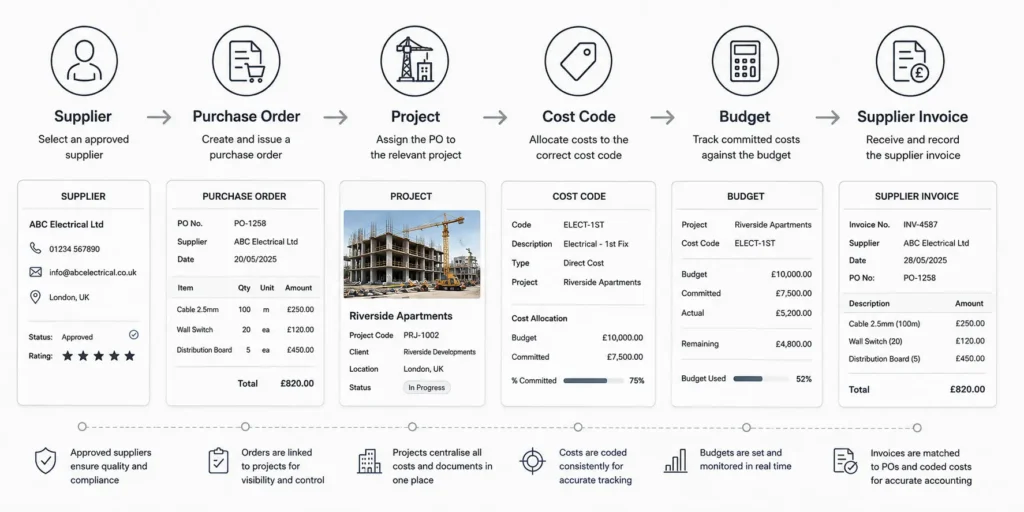
The invoice reaches finance with more of its project context already available.
Once reviewed and approved, the relevant financial information can move into the accounting system without project teams maintaining another disconnected version of the same transaction.
This can help contractors:
- Reduce duplicate data entry
- Improve project cost allocation
- Keep purchasing and invoices connected
- Identify committed costs earlier
- Reduce reliance on project spreadsheets
- Give finance and project teams more consistent information
- Keep project reporting more current
The objective is not simply to automate bookkeeping.
It is to create a more streamlined flow of financial information between construction projects and the company accounts.
How Does LiveCosts Connect Job Costing with Accounting Software?
LiveCosts is construction job costing and cost management software that connects project financial activity with accounting systems, including Xero, Sage and QuickBooks.
LiveCosts does not replace the contractor’s bookkeeper or accounting platform.
Instead, LiveCosts provides a construction-specific project layer where costs can be captured, allocated and reviewed while remaining connected to the job that generated them.
Purchase orders can be raised against project budgets and recognised as committed costs before supplier invoices arrive.
Deliveries can remain connected to their original orders.
Supplier invoices can be received, reviewed and assigned to the correct project and cost code before approved information moves into the accounting system.
Labour, subcontractor and other project costs can also contribute to the same project-level cost view.
This creates a connected construction financial workflow:
Project Budget → Purchase Order → Committed Cost → Delivery → Supplier Invoice → Job Cost → Accounting Software
Instead of reconstructing project costs from separate spreadsheets, emails and accounting transactions, LiveCosts keeps the project context attached to the financial activity.
One Connected View of Project Costs
The value of connecting job costing with accounting software goes beyond transferring data between systems.
Project managers need visibility of budgets, commitments and actual costs.
Finance teams need accurate bookkeeping and accounting records.
Quantity surveyors and commercial teams need reliable information for WIP, CVR, variations and margin reviews.
Connecting these workflows gives each team the information it needs without maintaining completely separate versions of project financial data.
For UK contractors, this can also provide clearer project records around subcontractor costs, CIS-related transactions, retentions, variations and other contract activity.
The workflow becomes simpler:
Site records the activity → LiveCosts keeps the project and cost context → Accounting software keeps the books.
Good construction bookkeeping creates reliable financial records. Connecting those records with construction job costing gives contractors something equally important: a clearer understanding of what those financial transactions mean for each project.